



In today’s healthcare classrooms, educators are preparing students for far more than certification exams—they’re preparing future caregivers to think, act, and engage with patients in profoundly human ways. During a recent CNA instructor webinar with Dr. Sue Roe, attendees explored how a holistic approach can transform not only caregiving, but also how students learn, practice, and ultimately succeed on exams.
Below is a deep dive into key takeaways from Dr. Roe’s session, along with practical ways educators can bring holistic strategies into their programs.
Why Holistic Practice Matters in Learning
Holistic caregiving recognizes the interconnectedness of body, mind, and spirit—and when applied to the learning environment, this approach helps students feel grounded, present, and prepared.
1. Caring for the Whole Learner
Dr. Roe emphasizes that students thrive when they feel:
- Healthy
- Safe
- Engaged
- Challenged
- Supported
These conditions reinforce the same principles CNAs bring to their patients. When instructors model holistic practice, students not only adopt these habits—they internalize them.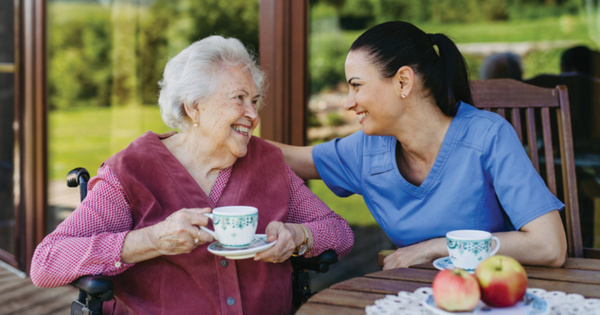
2. The Power of Centering and Mindfulness
Before students can absorb information or take an exam, they must quiet the noise around and within them. Dr. Roe introduced simple, effective methods educators can use:
- Centering breaths to slow the heart rate and increase focus.
- Guided mindfulness exercises to promote awareness without judgment.
- Body scan meditation to help students reconnect with physical sensations and reduce hidden tension.
These techniques take only minutes but can dramatically reduce anxiety and improve clarity—especially before quizzes, skills assessments, or certification exams.
3. Purpose: The Spiritual Component
Holistic practice includes the “spirit,” defined not as religion but as purpose, values, and motivation. When students understand why they are entering healthcare and reflect on their strengths, they build resilience, confidence, and emotional grounding—qualities that directly support test performance.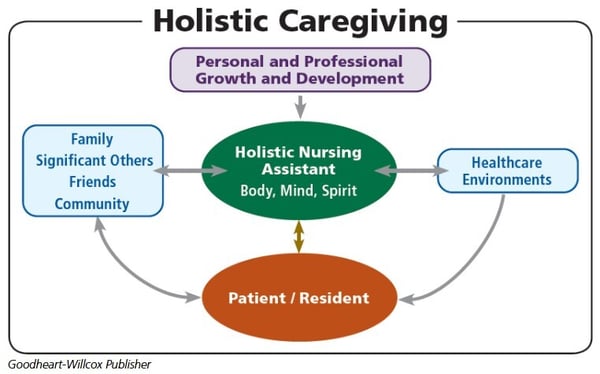
Educators were encouraged to ask students questions such as:
- Why do you want to be a nursing assistant?
- What personal qualities make you a strong caregiver?
These reflections help students replace negative self-talk with affirmations that rewire their thinking—something Dr. Roe notes is supported by the brain’s natural neuroplasticity.
Holistic Strategies for Better Test Taking
Test anxiety is extremely common—among new learners, seasoned professionals, and even Dr. Roe herself. Fortunately, holistic techniques can make test taking much more manageable.
Key strategies shared during the webinar:
✔ Use breathwork before and during a test
A few slow breaths help reduce anxiety, reset the body, and restore mental clarity.
✔ Practice positive self-talk
Students were encouraged to replace thoughts like “I’m going to fail” with “I’m prepared, capable, and ready.”
✔ Avoid last-minute cramming
Cramming overloads the brain, creating mental fatigue at the worst possible time.
✔ Visualize the test environment
Seeing the process mentally reduces fear of the unknown.
✔ Encourage rest, hydration, and protein intake
A properly nourished brain performs significantly better under pressure.
✔ Teach pacing and the STOP method
STOP = Stop, Take a breath, Observe, Proceed
This simple practice helps students reset if they panic during an exam.
✔ Normalize drawing a blank
Students can pause, breathe, and return to difficult questions later.
These strategies support not only improved performance but also long-term resilience beyond the classroom.
Enjoy Sue Roe’s webinar recording:
Holistic Practice Comes to Life in Dr. Roe’s Textbooks
This holistic approach and CNA certification prep are integrated into Sue Roe’s new editions of The Nursing Assistant: Foundations of Holistic Caregiving in both Comprehensive and Brief versions. The complete solutions include a textbook and study guide in print and online, as well as animations, videos, and interactive activities for online users. Instructors benefit from pre-made, customizable Online Instructor Resources, with lesson plans, answer keys, PowerPoints, and G-W Assessment.
 Get started today with a free Explore Instructor Sample:
The Nursing Assistant: Foundations of Holistic Caregiving, Comprehensive
The Nursing Assistant: Foundations of Holistic Caregiving, Brief
Holistic Teaching Is Holistic Caregiving
Dr. Roe’s message is simple:
When educators center themselves, support their students holistically, and create mindful, intentional learning environments, they aren’t just preparing CNAs to pass exams—they’re preparing compassionate practice-ready professionals to support patients with body, mind, and spirit in mind.
Photo Credits:
Thumbnail: Prostock/Shutterstock.com
Image 1: Goodheart-Wilcox Publisher
Image 2: Goodheart-Wilcox Publisher
Image 3: MBIShutterstock.com